Pilates for Injury Recovery: What You Need to Know | McKinney Movement Center
The Gap Nobody Talks About in Injury Recovery
Physical therapy is essential. If you've had a surgery, a significant injury, or a flare-up of a chronic condition, PT gets you from crisis to functional. It reduces acute pain, restores basic range of motion, and ensures the healing tissue is protected during the most vulnerable phase of recovery.
But there's a gap that physical therapy often doesn't close — and it's the gap that leaves people feeling like they've finished their PT, been discharged, been told they're 'cleared,' and yet still don't feel right. Still guarding. Still compensating. Still not trusting their body the way they used to.
That gap is where reformer Pilates lives. And for many people, filling it is what finally gets them back to the life they had before the injury — or better.
Why the Reformer Is So Effective for Rehabilitation
The reformer's spring resistance system is what makes it uniquely suited to rehabilitation. Springs provide what's called accommodating resistance — the load changes based on where you are in the range of motion, which means resistance can be gentle at the beginning of a movement and increase as you move into a stronger position. This mirrors how the body naturally functions and is far more joint-friendly than fixed-weight training.
More practically: the springs can be set light enough to allow movement around significant pain or restriction, while still providing enough load to create an adaptive stimulus. A post-surgical client who can barely lift their leg can still train the muscles surrounding the operated joint effectively. As strength and range return, the resistance increases to match.
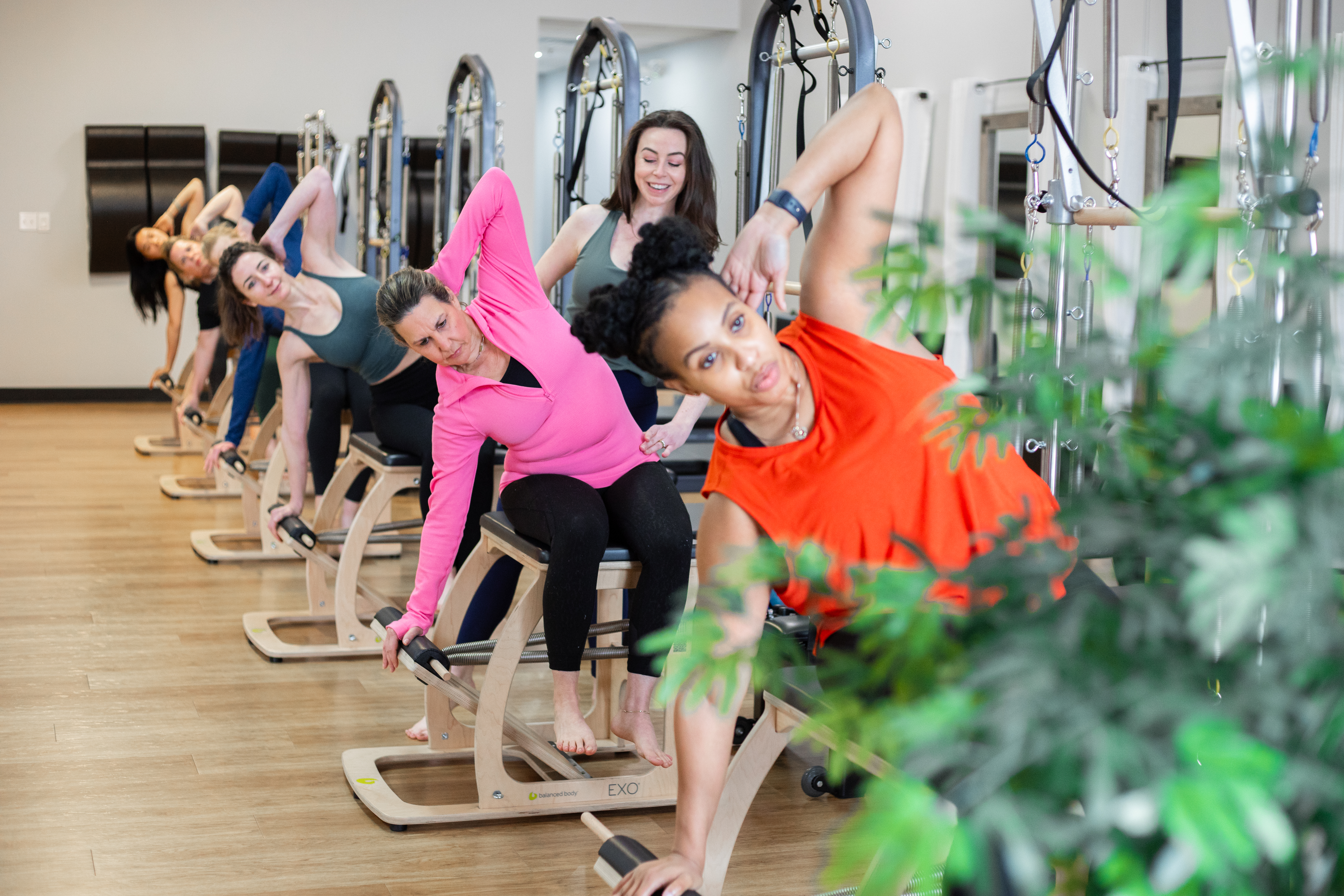
The reformer also allows for unloaded and partially loaded positions that free weights and machines simply can't replicate. Supine, sidelying, kneeling, seated — body position can be adjusted to take pressure off a healing structure while keeping the surrounding system active and rebuilding.
Conditions That Respond Consistently Well
Spinal Conditions and Back Injuries
Herniated and bulging discs, spinal stenosis, spondylolisthesis, post-spinal fusion recovery, and chronic non-specific low back pain all respond well to appropriately programmed reformer work. The key is reestablishing the deep stabilizing system — multifidus, transverse abdominis, pelvic floor — that protects the spine under load. These muscles are almost impossible to effectively target with conventional gym exercise and respond exceptionally well to the demands of reformer-based training.
Hip and Knee Reconstruction
Post-ACL reconstruction and hip replacement recovery are two of the most common surgical rehab scenarios we work with at McKinney Movement Center. The reformer allows progressive loading of the repaired structure in controlled, protected ranges while simultaneously building the surrounding hip and glute strength that reduces long-term re-injury risk. The carriage movement also allows for gait retraining and functional movement pattern restoration in ways that are difficult to replicate in traditional rehab settings.
Shoulder Injuries and Rotator Cuff
Rotator cuff tears, impingement syndrome, SLAP tears, and post-surgical shoulder recovery all benefit from the reformer's ability to load the shoulder in supported, controlled positions. Building the serratus anterior, lower trapezius, and external rotators — the muscles responsible for proper scapular mechanics — reduces impingement and supports full overhead function over time.
Neurological Conditions
Spinal cord injury recovery, post-stroke rehabilitation, and conditions like multiple sclerosis and Parkinson's disease all have documented benefit from Pilates-based exercise. The neuroplasticity principles that underlie these benefits — repetitive, intentional movement that challenges the nervous system to adapt — are inherent to Pilates methodology. At McKinney Movement Center, working with clients across the neurological spectrum is part of what makes our programming genuinely distinctive.
What to Tell Your Instructor Before You Start
Before your first session, your coach needs to know your full history. Not just the primary complaint, but everything — past surgeries, other injuries, conditions being managed medically, medications that affect your exercise tolerance, and a clear picture of what movements currently cause pain or discomfort.
There is no history that disqualifies someone from reformer Pilates. There are only movements that need to be modified, and in a class of six or fewer, your coach has the bandwidth to make those modifications in real time, every session. What you tell us shapes every decision we make in your programming.
If you're working with a physical therapist or physician currently, we welcome collaboration. We're not replacing your medical team — we're extending their work into a phase of training they typically don't have the capacity or scope to address.
What the Recovery Arc Looks Like
For most clients coming in from a recovery context, the arc looks something like this: the first two to four sessions are largely educational — learning the machine, establishing the movement vocabulary, and beginning to wake up muscles that have been underactive through the injury and recovery period. Sessions feel manageable but not explosive.
Weeks four through eight typically bring the most noticeable shift. Strength that felt absent begins returning. Compensations start resolving. Movements that required full concentration begin to feel more automatic. Most clients in this window report significant improvement in how their body feels outside the studio — less guarding, less fatigue, more confidence in their movement.
Beyond eight weeks, the work shifts from rehabilitation to genuine capacity building. This is where many clients discover that they're actually moving better than they were before the injury — because the rehab process required them to address compensations and weaknesses they'd been carrying for years without realizing it.
Frequently Asked Questions
Q: When can I start Pilates after surgery?
A: The timeline varies by procedure and surgeon. In most cases, once you've been cleared for 'light exercise' or 'low-impact activity,' reformer Pilates is appropriate with appropriate programming. Always confirm with your surgeon first.
Q: Do I need a referral to start Pilates for rehab?
A: No referral is needed to train at McKinney Movement Center. However, if you're in active post-surgical recovery, we'll want to know your surgeon's clearance status and any restrictions before your first session.
Q: Can Pilates make an injury worse?
A: Inappropriate programming can. Appropriate programming won't. This is why class size matters — a coach who can see your body and adjust your session in real time is fundamentally safer than a large group class where individual supervision is impossible.
Q: How is Pilates different from physical therapy?
A: PT addresses acute healing and basic function restoration. Pilates rebuilds the full strength, stability, coordination, and movement quality that allows you to live without restrictions — the phase that PT typically doesn't have the time or scope to complete.
Take the Next Step at McKinney Movement Center
If you're in McKinney, Frisco, Allen, or Plano and you're navigating an injury — whether you're fresh out of PT or you've been managing something chronic for years — come in for a free intro session. We'll talk through your history, get you on the reformer, and show you what's actually possible for your body from where you are right now.
Reference Links
• APTA — Exercise for low back pain: https://www.choosept.com/guide/physical-therapy-guide-low-back-pain
• NIH — Pilates for rehabilitation: https://www.ncbi.nlm.nih.gov/pmc/articles/PMC5744501/
