What Is Reformer Pilates — And Why Is Everyone Talking About It?
What Even Is Reformer Pilates?
If you've driven past a studio in McKinney or Frisco and noticed people moving on what looks like a cross between a bed and a piece of gym equipment — that's a reformer. And what happens on it is something most people have never experienced in a traditional gym setting.
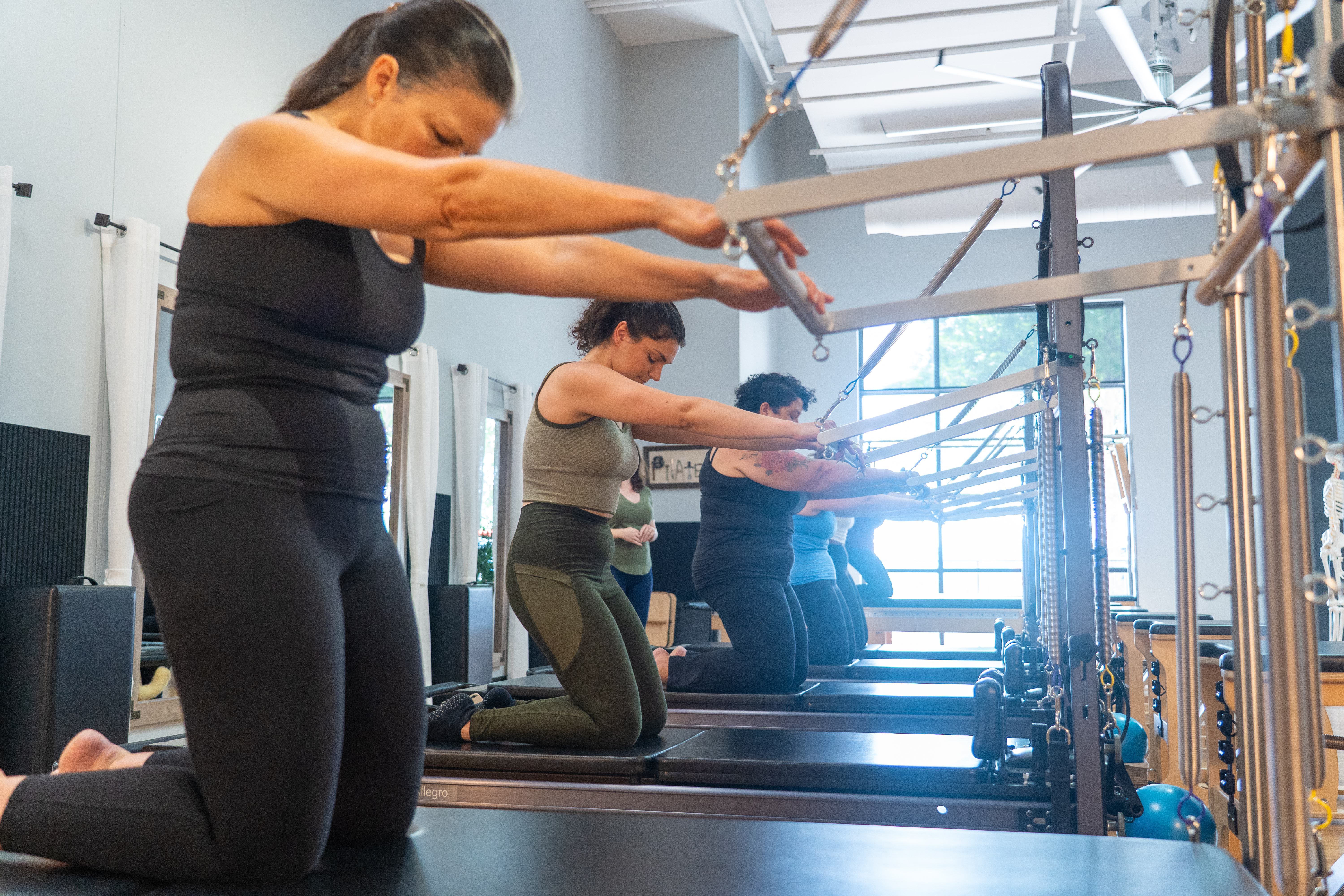
The reformer consists of a sliding carriage on a frame, connected to a set of adjustable springs that create resistance. Footbars, straps, and handles allow the body to be positioned in dozens of configurations, training movement in every plane — pushing, pulling, rotating, hinging, and stabilizing simultaneously. Unlike weight machines that isolate one muscle group at a time, the reformer demands full-body coordination on every single rep.
Reformer Pilates was developed by Joseph Pilates in the early 20th century and has been used by dancers, athletes, physical therapists, and rehabilitation specialists for decades. It's experiencing a major resurgence right now because the fitness industry is finally catching up to what movement specialists have known for years: training quality of movement produces better results than training quantity of effort alone.
How the Reformer Machine Actually Works
The resistance on a reformer comes from springs — typically color-coded by tension — that can be combined and adjusted to make any exercise easier or harder. This spring system is what makes the reformer unique. Unlike free weights, where gravity is the only load, the reformer creates resistance in multiple directions and across the full range of motion. It also provides assistance in certain positions, which makes it ideal for rehabilitation and for training movements that would otherwise be inaccessible.
The carriage slides on rails, and your movement controls it. If you push unevenly, the carriage drifts. If you rush, you feel it. If your core isn't doing its job, you know immediately. This built-in feedback loop is one of the reasons people develop body awareness on the reformer faster than in almost any other training modality.
At McKinney Movement Center, we use Balanced Body reformers — the gold standard in the industry — with classes kept to a maximum of six people so every client gets real-time coaching and setup that fits their body, not a generic approximation.
It's Not Just Stretching. It's Not Just Strength. It's Both.
One of the most persistent misconceptions about Pilates is that it's gentle stretching for people who aren't athletic enough for a 'real' workout. That myth evaporates fast on a reformer. The spring resistance challenges your muscles through a full, controlled range of motion — building strength while simultaneously improving mobility. You'll feel muscles you forgot you had, because you've probably been bypassing them for years.
Research published in the Journal of Bodywork and Movement Therapies has consistently shown that Pilates training improves muscular endurance, flexibility, balance, and core strength — often outperforming conventional exercise programs for specific outcomes like chronic low back pain reduction and postural improvement.
The key distinction is intentionality. Every movement on the reformer is deliberate. There's no momentum, no compensation, and no letting the stronger side take over. You train the whole system, not just the parts that already work well.
Who Is Reformer Pilates Actually For?
The honest answer: everyone. And we mean that without caveat. At McKinney Movement Center, our client list spans people recovering from spinal cord injuries, post-surgical rehabilitation clients, adults managing chronic pain, desk workers with postural issues, competitive athletes from high school through professional levels, and everyone in between.
The reformer is the only piece of training equipment we've encountered that is genuinely appropriate across that entire spectrum — because the spring system allows infinite adjustment of resistance, range of motion, and body position. The same piece of equipment that provides safe, supported movement for a client three weeks post-hip replacement can also challenge a Division I athlete's single-leg stability in ways their sport-specific training never has.
What does change based on the individual is the programming — the specific exercises selected, the spring tension used, the range of motion allowed, and the progressions applied over time. That's why small class sizes matter. Six people in a room with a knowledgeable coach is a fundamentally different experience than twenty people in a studio where the instructor can't see what your lumbar spine is doing.
Why People Who Have Never Loved Exercise Love Pilates
The gym culture can feel performative — how much you lift, how fast you run, how hard you work. Pilates culture is the opposite. The focus is entirely internal. How your body is moving, where you're creating tension you don't need, where you're compensating, where you have capacity you haven't tapped. There's no competition in the room. There's no benchmark to beat.
That internal orientation is what makes Pilates sustainable in a way that many other workouts aren't. People don't fall off the Pilates habit the way they fall off gym memberships, because each session teaches them something about their own body. Progress is measurable not just in reps or weight but in how you feel when you stand up from your desk, how your back responds to a long drive, how quickly you recover from a hard week.
What to Expect at Your First Class in McKinney
Your first reformer class will feel like a significant amount of new information arriving at once. That's completely normal and temporary. You'll spend time learning the vocabulary of the machine — how to adjust it, how to get on and off safely, what the resistance levels feel like — and beginning to understand the cues your instructor uses to help you find positions your body isn't used to inhabiting.
By your third session, the setup becomes automatic and the movement itself becomes the focus. By your sixth, most clients report a noticeable shift in how their body feels outside the studio. We tell every new client: give it three sessions before you judge it. Almost no one regrets that commitment.
At McKinney Movement Center, we start every new client with a conversation about their history, their goals, and any physical considerations we need to know about. Nothing you've been through disqualifies you. There are only movements that need to be modified, and that's exactly what a small class and an attentive coach are for.
Frequently Asked Questions About Reformer Pilates
Q: Is reformer Pilates hard for beginners?
A: It's challenging but manageable. The reformer provides feedback that actually makes learning easier — you can feel when you're doing something correctly. With a class of six or fewer, your instructor can coach you individually throughout every session.
Q: How is reformer Pilates different from mat Pilates?
A: The reformer adds spring resistance and allows for body positions that are impossible on a mat. Many exercises are more accessible on the reformer because the machine provides support, and others are significantly harder because the instability of the carriage demands more control.
Q: How often should I do reformer Pilates to see results?
A: Two to three sessions per week produces the most noticeable results for most clients. One session per week will maintain progress but builds more slowly. Consistency over time matters more than frequency in any given week.
Q: Do I need any experience or fitness level to start?
A: None. Reformer Pilates is genuinely adaptable to every fitness level and most physical conditions. If you have a specific injury or medical history, let us know before your first session so we can program appropriately.
Q: Where can I try reformer Pilates near McKinney TX?
A: McKinney Movement Center is located in the Craig Ranch area of McKinney, serving clients from McKinney, Frisco, Allen, Plano, and surrounding communities. We offer a free intro session for new clients — no experience required.
Ready to Try It?
If you're in McKinney, Frisco, Allen, or Plano and you've been curious about reformer Pilates, the best thing you can do is get on the machine. Reading about it only gets you so far — the experience of moving on a reformer for the first time is something you have to feel.
Book your free intro session at McKinney Movement Center. Small groups, expert coaching, and programming designed around your body and your goals. We'll take care of the rest.
Reference Links
• Pilates Method Alliance — What Is Pilates: https://www.pilatesmethodalliance.org/i4a/pages/index.cfm?pageid=3367
• Mayo Clinic — Core exercises: https://www.mayoclinic.org/healthy-lifestyle/fitness/in-depth/core-exercises/art-20044751
