Movement education
from the MMC team
Expert guidance on Pilates, Gyrotonic®, injury recovery, and getting the most out of your movement practice — from the certified instructors at McKinney Movement Center in McKinney, TX.
7 Things Reformer Pilates Is Surprisingly Good For
Most People Dramatically Underestimate What Pilates Does
Reformer Pilates has a branding problem. People hear 'Pilates' and imagine slow, gentle movement — something you do when you're too injured or too old for a 'real' workout. That stereotype is not just wrong; it's the reason many people never discover one of the most effective training tools available.
Here are seven things reformer Pilates is genuinely, quietly exceptional at — and the science and real-world results that back it up.
1. Resolving Chronic Back Pain That Nothing Else Has Fixed
Low back pain affects approximately 80% of adults at some point in their lives, making it one of the most common reasons people visit doctors, miss work, and reduce their activity levels. The frustrating reality is that most chronic back pain isn't caused by a specific structural problem — it's caused by how people move, or more accurately, how they've stopped moving correctly.
When the deep stabilizing muscles of the spine — the multifidus, transverse abdominis, and pelvic floor — become underactive, the lumbar spine absorbs forces it was never designed to handle. Tight hip flexors prevent proper hinging mechanics. Inhibited glutes force the lower back to compensate. The result is a spine under constant inappropriate load, and eventually, pain.
A landmark review published in the Journal of Orthopaedic and Sports Physical Therapy found that Pilates-based exercise significantly reduced pain and disability in patients with chronic low back pain compared to minimal intervention controls. At McKinney Movement Center, we see this pattern consistently: clients come in with back pain that's been present for months or years, and within six to eight weeks of consistent reformer work, most report meaningful, lasting improvement.
2. Building Core Strength That Actually Transfers to Real Life
Everyone talks about core strength, but most gym-based core training — crunches, sit-ups, even planks held in isolation — trains the trunk in ways that don't reflect how the core actually functions. Your core's primary job isn't to flex your spine. It's to stabilize your spine while your limbs are moving and under load.
The reformer trains exactly this. Every exercise on the machine requires the deep abdominal system to hold the spine in a neutral, protected position while the arms or legs — or both — work against spring resistance. There's nowhere to hide. If your core isn't doing its job, you feel it within seconds.
The result is core strength that transfers — to lifting, to running, to carrying your kids, to sitting at a desk for eight hours without your back aching by 3pm.
3. Injury Rehabilitation and Recovery
The reformer has been a tool of physical therapists and rehabilitation specialists for decades, and for good reason. The spring resistance system allows for precise load control that makes it possible to train effectively around almost any injury or surgical restriction.
Whether you're recovering from ACL reconstruction, a hip replacement, rotator cuff surgery, a herniated disc, or managing a neurological condition like a spinal cord injury, the reformer can be adjusted to meet your body exactly where it is — providing enough challenge to rebuild strength without risking the healing tissue.
At McKinney Movement Center, we've worked with clients across the full rehabilitation spectrum. The key is programming that respects the restriction while actively building everything around it. Our small class format means your coach sees your body every session and adjusts accordingly — something that simply isn't possible in a large group setting.
4. Exposing and Fixing Athletic Weaknesses (This One Surprises Athletes)
This is the one that catches athletes off guard. Clients who play competitive sports, lift heavy, or train hard regularly come in assuming Pilates will feel easy — and then discover muscles and stability demands they didn't know they were missing.
Heavy loading in sport-specific training tends to reinforce dominant movement patterns. Your stronger side compensates for your weaker side. Your global muscles cover for your stabilizers. You get stronger in your existing patterns, including the dysfunctional ones. The reformer, with its precise load control and demand for bilateral symmetry, exposes all of it.
Single-leg stability, rotational control, hip mobility, shoulder mechanics, deceleration patterns — these are the qualities that keep athletes healthy and performing at a high level, and they're exactly what the reformer trains. Many of the athletes we work with at McKinney Movement Center describe their first reformer sessions as humbling in the best possible way.
5. Improving Posture and Reducing the Effects of Desk Life
The modern postural crisis is real and predictable. Hours at a desk, in a car, or looking at a phone create a consistent pattern of dysfunction: hip flexors shorten, glutes inhibit, the thoracic spine rounds, shoulders roll forward, and the neck protrudes forward to compensate. The result — anterior pelvic tilt, rounded upper back, forward head posture — is increasingly the default adult body position.
Reformer Pilates addresses the structural cause of this pattern, not just the symptom. It strengthens the posterior chain, deep abdominals, and thoracic extensors that have become lengthened and weak. It lengthens the hip flexors, chest, and anterior shoulder structures that have become shortened and dominant. And critically, it trains the body to maintain a neutral position while moving — so the improvement sticks rather than reverting the moment you stop thinking about it.
6. Nervous System Regulation and Stress Response
The focused, breath-integrated nature of Pilates training requires sustained attention in a way that most workouts don't. You can zone out on a treadmill or go through the motions in a weight room. On the reformer, your full attention is required every single rep — and that sustained, deliberate focus has measurable effects on the nervous system.
Research on mind-body exercise modalities consistently shows activation of the parasympathetic nervous system during Pilates practice — the rest-and-digest state that counteracts the chronic low-grade stress response most adults are living in. Clients frequently report leaving class feeling both physically worked and genuinely calm, which is a combination that's difficult to achieve in high-intensity training environments.
7. Long-Term Movement Health and Longevity
This is perhaps the most underappreciated benefit of consistent Pilates practice. The qualities that reformer Pilates develops — joint mobility, muscular balance, body awareness, stability, breath control — are the exact qualities that research links to better functional outcomes as we age. Reduced fall risk. Better recovery from illness and injury. Greater independence and quality of life.
At McKinney Movement Center, we've worked with clients well into their 70s who are doing things on the reformer that would challenge people half their age — because they've invested years in the qualities that make the body resilient. The best time to start building that foundation is now, regardless of what your starting point looks like.
Frequently Asked Questions
Q: Is Pilates good for weight loss?
A: Pilates builds lean muscle and improves movement quality, which supports a healthy metabolism and body composition. It's most effective for weight-related goals when combined with good nutrition and appropriate cardiovascular activity.
Q: Can Pilates replace going to the gym?
A: For many people, yes — especially when the goal is functional strength, pain reduction, and longevity rather than maximum muscle mass. Many clients use Pilates as their primary training and add supplemental gym work as desired.
Q: How quickly will I see results from Pilates?
A: Most clients notice changes in how their body feels within two to three weeks of consistent training. Visible postural changes and significant strength improvements typically emerge between six and twelve weeks.
Q: Is Pilates good for older adults?
A: Pilates is one of the most appropriate exercise modalities for older adults. It's low-impact, highly adaptable, and specifically targets the qualities — balance, mobility, core stability — that decline most significantly with age and most affect quality of life.
Experience It at McKinney Movement Center
If any of these seven benefits sound like what you've been looking for — whether you're dealing with back pain, coming back from an injury, trying to improve your athletic performance, or simply looking for a smarter way to train — reformer Pilates at McKinney Movement Center is worth experiencing firsthand.
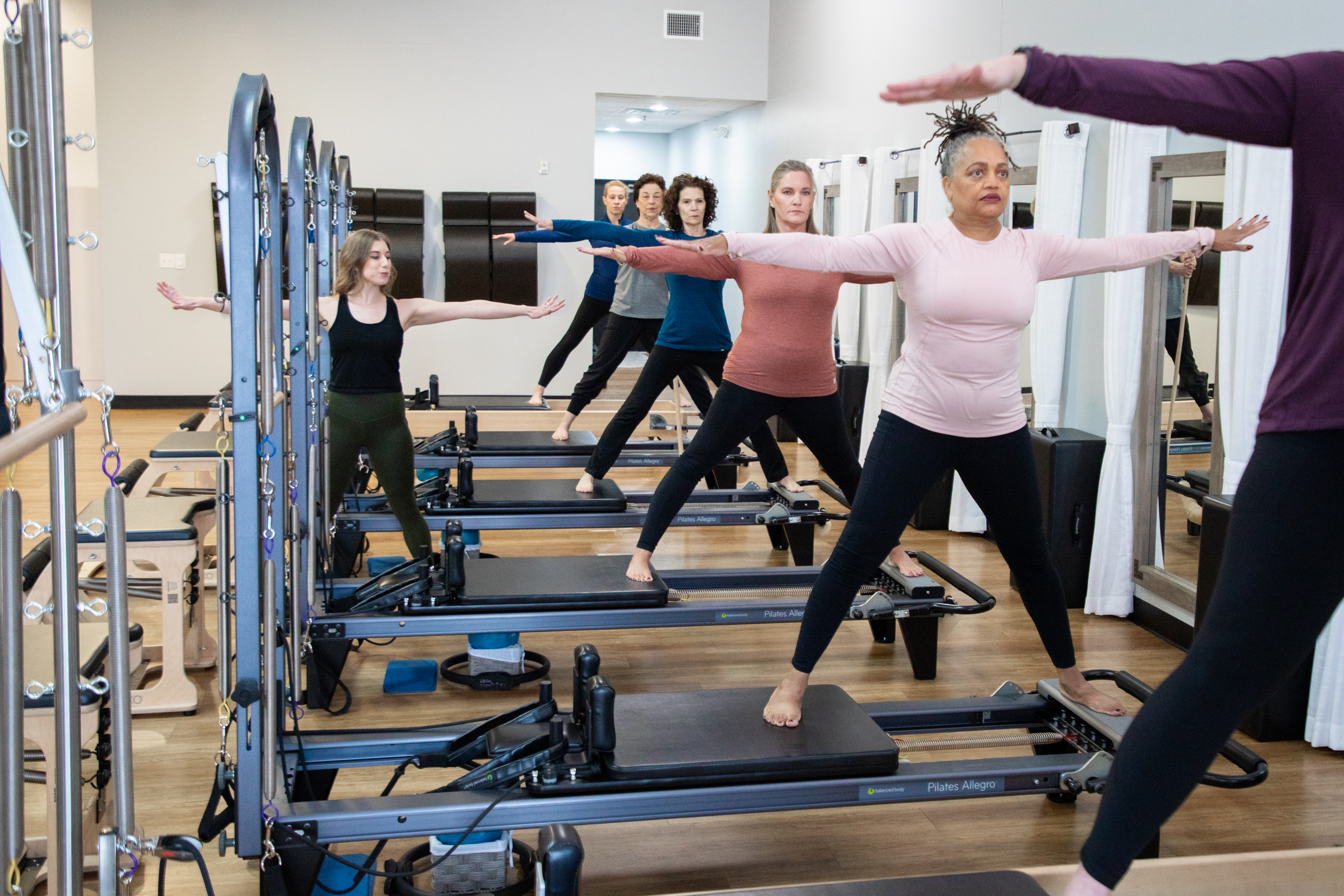
We serve clients from McKinney, Frisco, Allen, Plano, and the surrounding North Dallas communities. Classes are capped at six people for a reason: you deserve real coaching, not just supervision. Book your free intro session today and find out what your body is actually capable of.
Reference Links
• Harvard Health — The health benefits of Pilates: https://www.health.harvard.edu/staying-healthy/the-health-benefits-of-pilates
• NIH — Pilates for chronic low back pain: https://pubmed.ncbi.nlm.nih.gov/24435157/

Ready to move smarter?
Start with a free 45-minute consultation at McKinney Movement Center in McKinney, TX. No commitment, no pressure — just one conversation with a certified instructor about your goals.
New Clients — Start Here