Pilates is the fitness world's best-kept secret
You've heard the name. Maybe you've tried a class. But most people — even regular exercisers — don't fully understand what Pilates actually is, where it comes from, or why it produces results that other training methods can't replicate. That's exactly what this page is for.
Pilates is a comprehensive movement system developed over 100 years ago by Joseph Pilates. He originally called it Contrology — the study of control — because the method is built around training your body to move with precision, intention, and efficiency. Not just working out. Actually learning how to move.
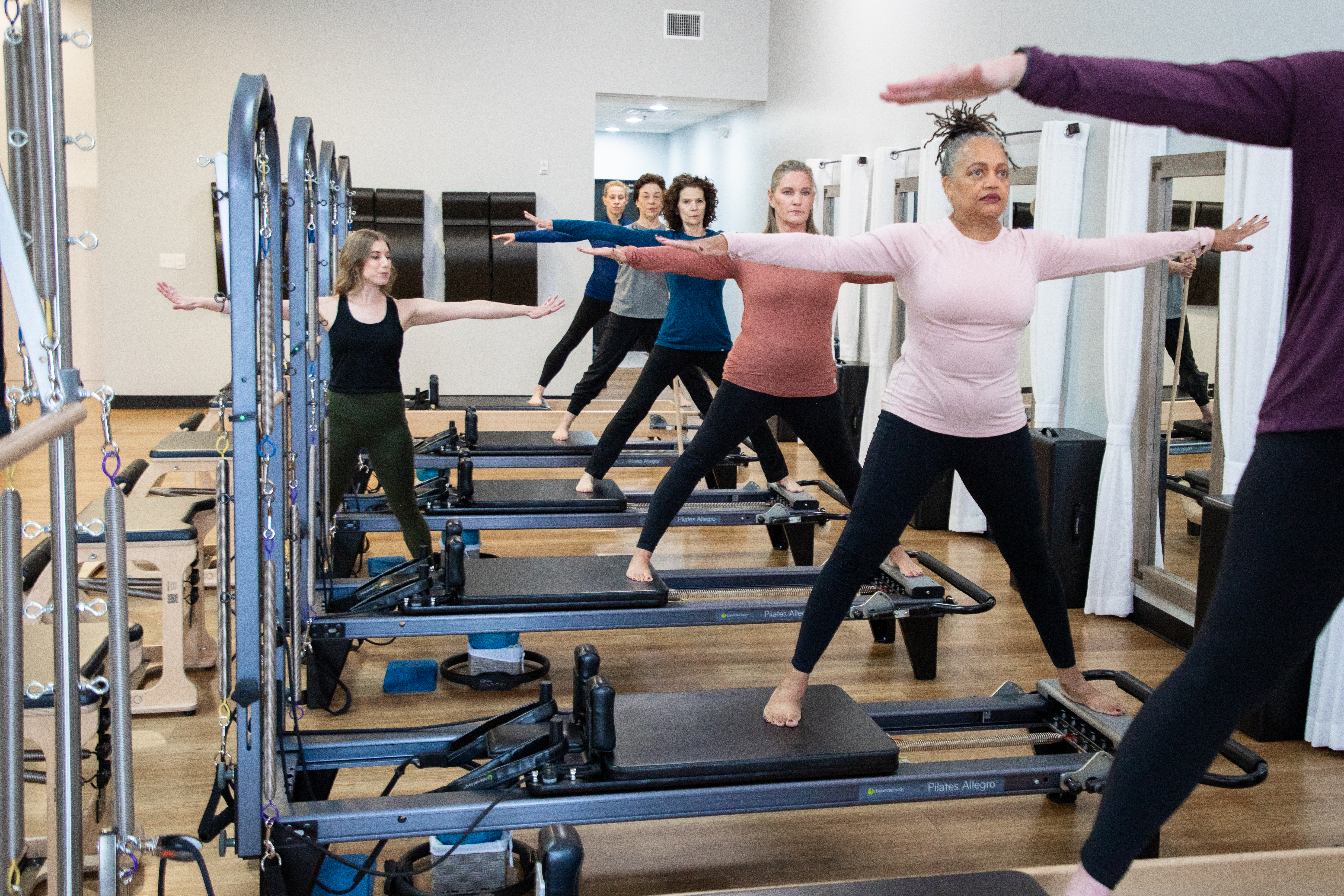
It's one of the only training methods that has remained largely unchanged since its creation, because the original system is that complete. At McKinney Movement Center, we teach traditional equipment Pilates — the full method, on the full range of apparatus — in small groups of six so every client gets the attention the method was designed to deliver.
Three things Pilates is not
Before we go further, let's bust the three most common misconceptions — because they keep a lot of people from trying something that would genuinely change how their body feels.
Joseph Pilates was a man. He developed the method to rehabilitate injured soldiers and athletes in the early 20th century, and it was adopted by professional athletes and dancers long before it became mainstream fitness. Today our client base at MMC spans from professional baseball players to grandmothers — the method works for all of them because it meets each body where it is.
As for intensity — Pilates done correctly is genuinely challenging. The difference is it challenges your nervous system and movement quality, not just your cardiovascular system. You'll feel muscles you didn't know you had. And the full Pilates system goes far beyond the reformer — there are six major pieces of apparatus and hundreds of exercises that make up the complete method.
"Physical fitness is the first requisite of happiness. Our interpretation of physical fitness is the attainment and maintenance of a uniformly developed body with a sound mind fully capable of naturally, easily, and satisfactorily performing our many and varied daily tasks with spontaneous zest and pleasure."
Why Pilates gets results other methods don't
Most exercise approaches train the body in isolation — a bicep curl works the bicep, a squat works the legs. Pilates trains movement patterns. Every exercise involves your core, your alignment, and the coordination of multiple muscle groups working together. That's why clients who have been training for years often discover entirely new weaknesses when they start Pilates — and why they see changes in their bodies faster than they expected.
Core strength that actually transfers
Pilates builds what Joseph Pilates called the "powerhouse" — the deep stabilizing muscles of the trunk that support every movement you make. This isn't the six-pack you see in the mirror. It's the deep abdominal, back, pelvic floor, and hip muscles that provide the foundation for all movement. Strengthening these changes how everything else feels — back pain, posture, athletic performance, everyday function.
Alignment and posture correction
Pilates teaches your body its correct structural alignment — and trains it to maintain that alignment under load and in motion. For clients who have spent years sitting at a desk, compensating around an old injury, or moving with patterns that cause pain, this is often the missing piece. You're not just stretching or strengthening — you're reprogramming how you stand, walk, and move through life.
Balanced, full-body strength
One of the hallmarks of traditional Pilates is that it builds strength symmetrically — both sides, all planes of movement, the full kinetic chain. For athletes this translates to better performance and reduced injury risk. For general clients it means a body that moves and feels balanced, not one where some muscles are overdeveloped and others are dormant.
Injury rehabilitation and prevention
Pilates has a long clinical history in rehabilitation. At McKinney Movement Center our instructors are certified in Scolio Pilates, Buff Bones, and have extensive experience working alongside physical therapists. We work regularly with clients recovering from back surgery, joint replacements, and neurological conditions — and with athletes training to prevent future injury. The method's controlled, low-impact nature makes it uniquely suited to this work.
The Pilates equipment — all of it
At McKinney Movement Center we teach traditional equipment Pilates on the full range of apparatus. Each piece offers different spring resistance, body positioning, and movement possibilities — together they create a complete training system that can be adapted for any body and any goal.
The signature Pilates apparatus. A sliding carriage with spring resistance that enables hundreds of exercises in lying, sitting, kneeling, and standing positions. Our small-group reformer classes are the foundation of the MMC experience.
A vertical frame with spring bars, roll-down bars, and leg springs. Exceptional for spinal articulation, hip mobility, and working the body in ways the reformer can't. Clients with back issues often find this the most transformative piece.
A deceptively small and challenging piece. The chair builds single-leg strength, balance, and functional movement patterns. Advanced work on the chair is some of the most demanding in the entire Pilates system.
Curved apparatus that supports and articulates the spine. Excellent for back extension, hip flexor lengthening, and opening the chest — areas that are chronically tight in most modern bodies.
A modern evolution of the Wunda Chair with expanded functionality. The EXO Chair is versatile for standing, seated, and kneeling work — particularly effective for functional strength and athletic training.
The original Pilates work — no equipment, just you and the mat. Mat Pilates is more demanding than it looks because there's no spring resistance to assist your movement. Everything comes from your own body's strength and control.
Every body. Every level.
We work with clients across an enormous range at McKinney Movement Center — from people recovering from spinal cord injuries to professional athletes training at the highest level, often in the same week. The Pilates system is uniquely adaptable because it's built around principles, not fixed routines. An exercise can be modified to be gentle enough for a post-surgical client or challenging enough for a professional dancer. That's not a compromise — that's the design of the method.
Our instructors are trained in Scolio Pilates and Buff Bones and work alongside physical therapists. Pilates is one of the most effective tools for rebuilding strength, restoring alignment, and moving through recovery without re-injury.
Back pain is usually a movement problem — weak deep stabilizers, poor alignment, compensatory patterns. Pilates addresses all three. Many of our clients come in with years of back pain and find lasting relief through consistent practice.
Our owner Emily is Titleist Performance Institute certified and has trained MLB pitchers and elite athletes. Pilates improves mechanics, reduces injury risk, builds rotational strength, and extends athletic careers. It's not cross-training — it's a performance tool.
Reformer Pilates builds long, functional muscle without the joint stress of high-impact training. If you've been working out consistently and not seeing the changes you want, a different kind of work — focused, controlled, progressive — often makes all the difference.
Pilates is one of the safest and most effective forms of exercise during and after pregnancy. The focus on pelvic floor strength, core stability, and controlled movement is particularly valuable for postnatal recovery.
Our Buff Bones® certified instructor works specifically with clients focused on bone density, fall prevention, and maintaining mobility as they age. Pilates is low-impact but load-bearing — the right combination for long-term skeletal health.
How Pilates works at McKinney Movement Center
Every new client at MMC starts with a free 45-minute consultation. This isn't a sales pitch — it's a conversation. We want to understand your history, your goals, what's worked and what hasn't, and what your body needs right now. From there we recommend the right entry point: a group class, private sessions, or duet training.
Our small-group classes have a maximum of six clients. That's intentional. At six people, your instructor can watch every body in the room — not just glance around a class of twenty. They'll see when you're compensating, know when to push you and when to back off, and build sessions that evolve as you get stronger. No two sessions at MMC are ever the same.
We're located near Craig Ranch in McKinney and serve clients from across the North Texas area — McKinney, Frisco, Plano, Allen, and beyond. Free parking at the studio, no dress code, and a first consult that's completely free.